

Ideas That Challenge.
Stories That Inspire.
Explore insights on focus, leadership, communication, psychology, and personal growth—drawn from years on stage, behind the scenes, and in everyday life.
School Assemblies in Omaha & Nebraska | Hocus Pocus, I Can Focus! School Assembly Program
Schools Are Booking Fall Assemblies This Time of Year
Every year, right around this time, I begin hearing from principals, teachers, counselors, PTO leaders, and school administrators who are planning their fall school assemblies.
Some are preparing for the first weeks of school. Others are looking ahead to Red Ribbon Week, character education programs, PBIS celebrations, testing motivation, reading rewards, family nights, and end-of-semester events.
And once again, my school assembly calendar is beginning to fill.
Over the years, I have traveled from coast to coast presenting my Hocus Pocus, I Can Focus! magic keynote for students. I have performed in packed gymnasiums, school auditoriums, cafeterias, theaters, libraries, conference centers, and just about every other kind of room you can imagine.
But I am always especially excited when schools begin calling from Omaha, Bellevue, Papillion, La Vista, Ralston, Lincoln, Grand Island, Kearney, Council Bluffs, Kansas City, Des Moines, Sioux Falls, Minneapolis, and communities throughout the Midwest.
This is home.
And there is nothing better than bringing a program I have developed across decades of performing, teaching, speaking, and studying human behavior back to students in my own part of the country.
This Is Not Just a School Magic Show
Students love the magic.
They love the juggling, the yo-yos, the spinning tops, the card throwing, the comedy, the audience participation, and the moments when something happens onstage that seems completely impossible.
That is what gets their attention.
But what we do with that attention is what matters.
Hocus Pocus, I Can Focus! is a visual motivational keynote built around focus, perseverance, creativity, self-discipline, and pushing through failure.
Instead of simply telling students to focus, I show them what focus looks like.
Instead of telling them not to give up, I demonstrate what happens when someone keeps practicing after the first attempt fails.
Instead of delivering another lecture about making good choices, I use physical skills, stories, comedy, and symbolism to help students see those choices differently.
People listen best while watching.
That has always been one of the guiding principles behind my work.
Turning Skills Into Symbols
One of the most powerful parts of the program is the use of symbolism.
A juggling ball is not just a juggling ball.
When it drops, it can represent failure.
When I pick it back up, it represents another attempt.
A spinning top can represent balance and concentration.
A deck of cards can represent choices.
A yo-yo can demonstrate control, patience, timing, and practice.
A seemingly impossible skill can become a symbol of what happens when someone stays focused long enough to improve.
Students may not remember every sentence they hear during a school assembly.
They do remember the moment.
They remember the object.
They remember the laughter.
They remember what they saw.
And sometimes that visual memory returns at exactly the right time.
When a student becomes frustrated with schoolwork, they may remember the dropped juggling ball.
When something does not work on the first attempt, they may remember that the successful moment onstage only happened because there were many unsuccessful attempts before it.
When distractions begin pulling their attention in ten directions, they may remember what happened when the performer lost focus.
That is where a magic show becomes something more.
Focus Is Something Students Can Practice
Students are told to focus constantly.
Focus on the lesson.
Focus on the assignment.
Focus on the test.
Focus on what the teacher is saying.
But we do not always explain what focus actually is or how it becomes stronger.
Focus is not a personality trait that some people have and others do not.
It is a skill.
And like every skill, it improves through practice.
The world students are growing up in is filled with distractions. Phones, videos, games, notifications, social media, conversations, entertainment, and constant stimulation are all competing for their attention.
That makes the ability to direct attention more valuable than ever.
During Hocus Pocus, I Can Focus!, students see that improvement rarely happens all at once.
It happens one attempt at a time.
One throw.
One catch.
One miss.
One correction.
One more try.
That is how someone learns to juggle.
It is also how someone learns to read, solve equations, play an instrument, improve at a sport, speak in front of a group, develop confidence, and accomplish almost anything worthwhile.
Failure Is Part of the Performance
Students usually see the finished product.
They see the trick that works.
They see the ball that is caught.
They see the top that stays balanced.
They see the performer standing confidently in front of the room.
What they do not see are the hundreds or thousands of attempts that happened before the performance.
That can create the impression that successful people are simply born with abilities that everyone else does not have.
I want students to see the truth.
Skills are built.
Confidence is built.
Focus is built.
Failure is part of that construction process.
The first time I tried many of the skills in my school assembly, I was terrible at them.
The objects fell.
The cards missed.
The yo-yo tangled.
The trick failed.
The routine did not work.
The important part was not that I failed.
The important part was what happened next.
I tried again.
That does not mean every student has to become a magician, juggler, or performer.
It means they can learn to stop treating one unsuccessful attempt as a final answer.
Failure provides information.
It shows us what needs to change.
It teaches us to adjust.
It forces us to pay attention.
It asks whether the goal matters enough for us to continue.
A student does not need to be perfect to make progress.
The student simply needs to make the next attempt.
A School Assembly Has to Hold the Room
A strong message is important, but a school assembly also has to be entertaining.
There is an enormous difference between speaking to twenty adults in a conference room and engaging several hundred students in a gymnasium.
Students are honest.
When they are interested, you know it.
When they are not interested, you definitely know it.
The pacing has to be right.
The visuals have to be large enough for the back row.
The comedy has to work for the age group.
Audience participation has to feel exciting without allowing the room to become chaotic.
The presenter must be able to read the students, adjust in the moment, cooperate with the staff, and keep the entire experience moving.
I have spent more than twenty-five years working as a professional speaker and entertainer. My background includes magic, comedy, juggling, mentalism, hypnosis, psychology, storytelling, martial arts, education, and live audience engagement.
All of those disciplines come together in this program.
This is not a motivational speech with a few magic tricks inserted between the talking points.
It is a complete visual presentation designed from the beginning for live student audiences.
School Assemblies for Different Grade Levels
A kindergarten audience is not the same as a fifth-grade audience.
Middle school students are not simply taller elementary students.
High school students know immediately when someone is talking down to them.
That is why the presentation changes depending on the age of the audience.
Elementary School Assemblies
For elementary students, the program can focus on:
Listening and following directions
Practicing new skills
Staying with a difficult task
Handling mistakes
Using creativity
Managing distractions
Building confidence
Understanding that abilities improve through effort
The presentation is fast-moving, highly visual, funny, and easy to follow.
Middle School Assemblies
Middle school students are dealing with new expectations, social pressure, comparison, embarrassment, identity, and increasing independence.
For middle school audiences, the program can explore:
Focusing in a distracting world
Continuing after an embarrassing mistake
Practicing when no one is watching
Building real confidence
Choosing what deserves attention
Handling frustration
Developing abilities instead of only watching other people demonstrate theirs
High School Assemblies
For high school students, the same ideas can connect to:
Leadership
Goal setting
Personal responsibility
Career preparation
Communication
Resilience
Decision-making
Building a future through repeated action
Separating appearance from real accomplishment
The language and examples change, but the core principle remains the same:
What students repeatedly focus on, practice, and pursue will help shape the person they become.
School Assembly Programs for Many Occasions
Schools book Hocus Pocus, I Can Focus! for many different events throughout the year, including:
Back-to-school assemblies
Welcome-back programs
Student motivation events
PBIS celebrations
Character education programs
Red Ribbon Week
Drug-free school programs
Bullying prevention events
Testing motivation
State assessment preparation
Reading celebrations
Accelerated Reader rewards
Attendance incentives
Academic achievement programs
Student recognition events
Leadership conferences
Student council programs
Career days
Family nights
PTO and PTA events
School carnivals
After-school programs
Summer school
Summer learning programs
Library programs
Youth conferences
Community education events
End-of-year celebrations
Teacher appreciation programs
School district conferences
The assembly can stand on its own or support a larger school theme involving focus, perseverance, positive choices, resilience, creativity, leadership, or personal growth.
Omaha and Nebraska School Assembly Programs
I am based in the Omaha area and regularly travel throughout Nebraska and the Midwest.
Schools often find me while searching for:
Omaha school assemblies
Nebraska school assembly speakers
Educational magic shows
Motivational school speakers
Elementary school assembly programs
Middle school motivational assemblies
Student focus programs
Character education assemblies
Red Ribbon Week speakers
PBIS assembly entertainment
School assembly magicians
Educational entertainers
Youth motivational speakers
I am available for programs in Omaha and throughout the surrounding metro area, including:
Omaha
Bellevue
Papillion
La Vista
Ralston
Millard
Elkhorn
Gretna
Bennington
Blair
Fremont
Plattsmouth
Springfield
Valley
Waterloo
Boys Town
Council Bluffs
I also travel throughout Nebraska to communities such as:
Lincoln
Grand Island
Kearney
Hastings
Norfolk
Columbus
North Platte
Scottsbluff
Gering
Alliance
Chadron
McCook
York
Seward
Beatrice
Nebraska City
Falls City
Auburn
Crete
Wahoo
Ashland
Schuyler
Wayne
South Sioux City
Lexington
Holdrege
Broken Bow
Ogallala
Sidney
Valentine
School Assemblies Throughout the Midwest
Because Omaha is centrally located, I can easily travel to schools throughout Iowa, Kansas, Missouri, Minnesota, and South Dakota.
Iowa
Council Bluffs, Glenwood, Harlan, Atlantic, Red Oak, Shenandoah, Denison, Carroll, Sioux City, Des Moines, West Des Moines, Urbandale, Ankeny, Ames, Fort Dodge, Waterloo, Cedar Falls, Cedar Rapids, Iowa City, Davenport, Dubuque, Mason City, Marshalltown, and Ottumwa.
Kansas & Missouri
Kansas City, Overland Park, Olathe, Lenexa, Shawnee, Lawrence, Topeka, Manhattan, Wichita, St. Joseph, Independence, Lee's Summit, Blue Springs, Liberty, Columbia, Springfield, Branson, and St. Louis.
Minnesota & South Dakota
Minneapolis, St. Paul, Rochester, Mankato, St. Cloud, Worthington, Sioux Falls, Brookings, Mitchell, Yankton, Vermillion, Aberdeen, and Rapid City.
I also travel nationally and have presented school programs from coast to coast.
Several Schools Can Work Together
One of the best ways to reduce travel expenses is for several schools in the same area to coordinate their dates.
A district might schedule several elementary schools over two or three days.
A smaller rural school might work with a nearby school, library, or youth organization.
A school may schedule an assembly during the day and add a family program in the evening.
Depending on the location and schedule, schools may be able to:
Share travel expenses
Arrange multiple programs in one district
Schedule different presentations for different grade levels
Combine smaller schools at one location
Add an evening family event
Coordinate with a library or community organization
This can help smaller schools bring in a professional national presenter without carrying the entire travel expense alone.
What Schools Can Expect
My goal is to make the program exciting for students and easy for the school.
Depending on the venue and event, the presentation may include:
Professional sound equipment
Visual magic
Juggling
Yo-yos
Spinning tops
Card throwing
Comedy
Student volunteers
Audience interaction
Stories about learning and persistence
Demonstrations of focus and practice
Age-appropriate motivational content
Clear communication before the event
The school receives a complete presentation, not simply a performer showing up with a box of tricks.
Fall Dates Are Beginning to Fill
Schools often begin planning fall programs months before the students arrive.
Back-to-school events, Red Ribbon Week, PBIS celebrations, family nights, and district programs tend to fall within a few high-demand windows.
That means the most popular dates can be booked early.
It is especially helpful to begin the conversation early when:
Your school needs a specific date
Several grade levels require separate presentations
Multiple schools want to coordinate
Travel is involved
The program is connected to Red Ribbon Week
The assembly supports a district-wide theme
You would like to add an evening family program
You do not need to have every detail finalized before contacting me.
The first step is simply determining the date, location, grade levels, approximate audience size, and the goal of the event.
Give Students Something They Will Remember
A school assembly should not feel like an interruption in the school day.
It should support the work teachers and administrators are already doing.
Students should:
Laugh.
Participate.
Be surprised.
See something they did not think was possible.
Leave with an idea they can use.
Because in the end:
Focus matters.
Practice matters.
Failure is not final.
Distractions have a cost.
The ability that looks impossible today may become possible after enough focused attempts.
That is the purpose of Hocus Pocus, I Can Focus!
It is a school assembly students want to watch, built around a message they need to hear.
Book Hocus Pocus, I Can Focus!
Schools are now booking programs for the coming school year throughout Omaha, Bellevue, Papillion, La Vista, Ralston, Lincoln, Grand Island, Kearney, Kansas City, Des Moines, Sioux Falls, Minneapolis, and communities across the Midwest.
To check availability for Hocus Pocus, I Can Focus!, fill out the School Assembly Inquiry Form at AmazingArthur.com.
Marvin will review your information, answer your questions, and help reserve your preferred date.
Please Include:
School or organization name
City and state
Preferred date or date range
Grade levels
Estimated audience size
Type of event
Goals for the assembly
Contact
Email: [email protected]
The earlier you submit your inquiry, the better the chance of securing your preferred date, especially for back-to-school assemblies, Red Ribbon Week, testing season, PBIS celebrations, and end-of-year events.
Let's Give Your Students Something They'll Remember
Students may not remember every lesson they hear, but they will remember how they felt.
They will remember laughing.
They will remember participating.
They will remember accomplishing something they never thought possible.
And long after the assembly ends, they may remember one simple idea:
Focus on what matters. Practice with purpose. Never let one failure become your final answer.
Ready to bring Hocus Pocus, I Can Focus! to your school? Request your preferred date today and let's create an unforgettable experience for your students.

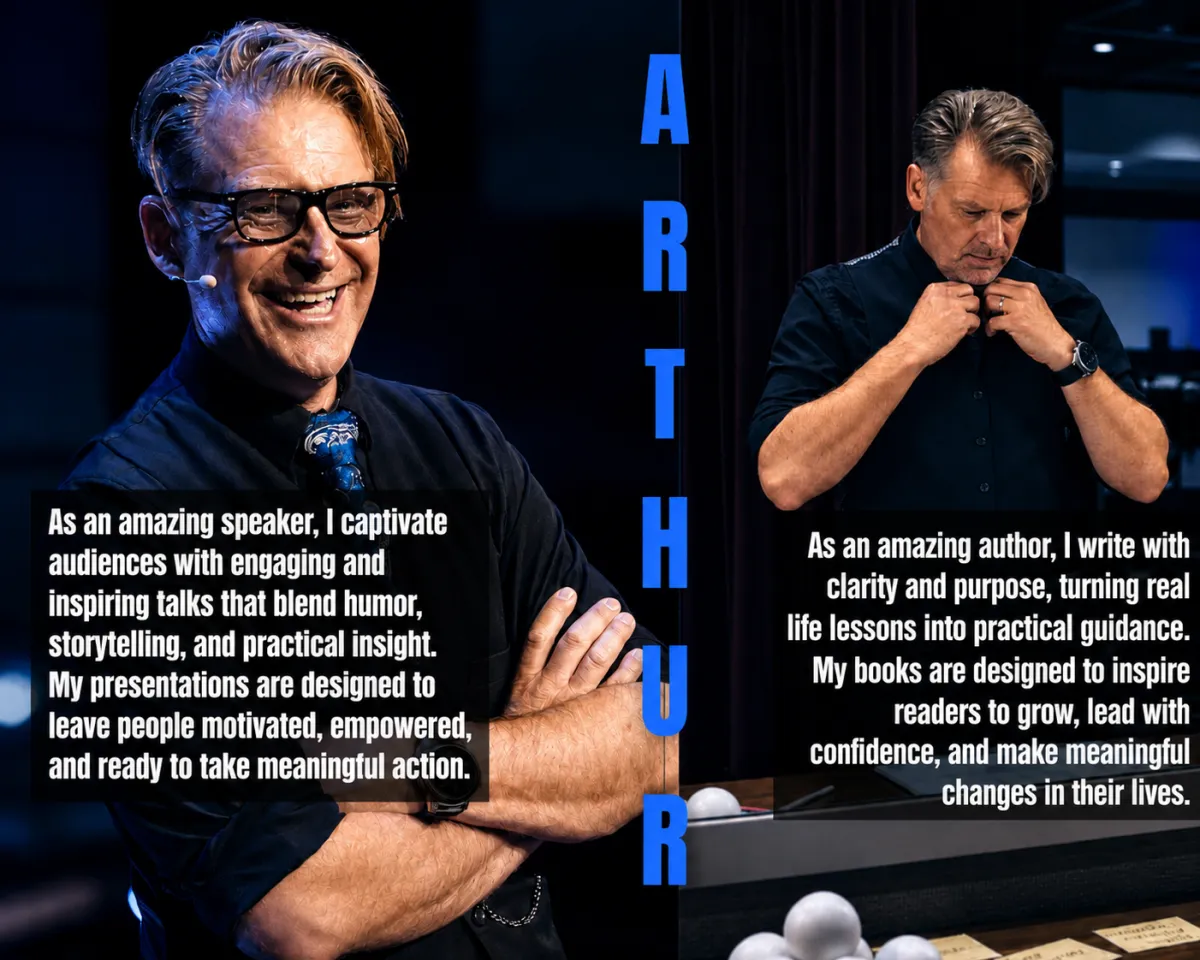
AMAZING ARTHUR
Not Just a Corporate Speaker, But an Author Inspiring Meaningful Change
The Amazing Arthur joined us for our annual office holiday party and we couldn't be more impressed and happier with the entertainment he provided. From the initial booking to communication leading up to the event through to the very end of the evening, Arthur was professional, kind, organized and most importantly, entertaining. He had the entire crowd laughing for an hour straight! Thanks for sharing your talents with our group, we thoroughly enjoyed the show and appreciate you!

Hired for an event and what a professional and amazing performer. He was on time for our event, gave an "amazing" performance, and we couldn't believe how reasonable his rate was for such a great show. Hands down the best entertainer in Omaha and would not hesitate to hire him again. Easy 5 Stars!

We booked Arthur for our Corporate Christmas party. He kept a room of 450 thoroughly entertained for the complete show. To make every demographic watch, laugh, pay attention and entertain is truly Amazing! If you are looking for entertainment for your next corporate event. Yeah, get this guy. Worry about other party details, and definitely not the entertainment, when you have Arthur booked.

Laugh, Learn, and Be Inspired with me.
Need your audience awake without making the coffee stronger?
Whether you’re booking a comedy show, a motivational talk, or a special event, Arthur delivers unforgettable moments filled with laughter and insight.