

Ideas That Challenge.
Stories That Inspire.
Explore insights on focus, leadership, communication, psychology, and personal growth—drawn from years on stage, behind the scenes, and in everyday life.

Your Employees Don't Want Another Holiday Party. They Want a Story.
Every company holiday party eventually becomes a story.
The only question is whether it's a good one.
Sometimes it's:
"Remember when we had that incredible party and nobody could figure out how the hell that guy knew what Linda was thinking?"
And sometimes it's:
"Remember when we waited 45 minutes for chicken?"
Both are stories.
I know which one I'd rather be responsible for.
After more than 25 years of performing for audiences, I've become increasingly convinced that we think about events backward.
We obsess over what we're going to have.
What venue are we going to have?
What food are we going to have?
Will we have a DJ?
Will we have an open bar?
Will we have centerpieces?
Will Gary have three drinks before the awards presentation?
Gary will.
But those aren't really the questions that determine whether people remember an event.
The better question is:
What is going to happen?
Because things become memories.
Memories become stories.
And stories are what people keep.
Nobody Remembers an Agenda
Think about your own life.
Your best memories probably aren't inventories.
You don't fondly recall having a table, six chairs, hors d'oeuvres, and adequate parking.
You remember something happening.
Something hilarious.
Something unexpected.
Something going completely wrong and somehow becoming better because it did.
You remember the night somebody said something that made everyone lose it.
You remember seeing something you couldn't explain.
You remember your friend getting pulled into something and becoming the star of the evening.
Human beings turn experiences into stories.
We've been doing it considerably longer than we've been doing PowerPoint.
And that's what fascinates me about live entertainment.
A good show doesn't simply give people something to watch.
It gives them something to remember together.
Every Company Already Has Its Own Mythology
Spend enough time around any group of people and you'll discover they have folklore.
Not Lord of the Rings folklore.
Probably.
Although I don't know your accounting department.
I mean the stories everybody knows.
There was the Christmas party when...
There was that sales meeting where...
Remember what happened to Dave?
Remember when the boss tried to...?
Remember the retreat when we...?
New employees eventually hear these stories from old employees.
People retell them at lunch.
Someone mentions one three years later and half the table starts laughing before the story is even finished.
That's culture in one of its most human forms.
Not the culture written on the lobby wall.
The culture people actually experience.
Companies spend enormous amounts of time trying to create connection through mission statements, meetings, retreats, and team-building exercises.
But connection frequently sneaks in through a side door.
It happens when people experience something together.
The Secret Ingredient Is Other People
This is where performing mentalism and comedy for corporate audiences gets interesting.
I can show an audience something impossible.
That's fun.
But if I can make something impossible happen with someone they know, it changes.
That's their person up there.
Now the room is invested differently.
The person from accounting isn't "a volunteer."
She's Linda.
And Linda apparently just made a completely free choice that I somehow predicted before the show began.
That's different.
Suddenly everybody is watching Linda.
They're watching me.
They're watching each other watching Linda.
That's a shared moment.
And when Linda comes to work Monday morning, the experience comes with her.
That's why I don't think audience participation should be about dragging some unfortunate employee onto a stage and making him regret attending the Christmas party.
The volunteer isn't there to make me look good.
My job is to make them look good.
There's a tremendous difference.
The audience should be thinking:
"I wish that happened to me."
Not:
"Dear God, don't make eye contact with him."
Your Audience Should Become the Cast
One of the great mistakes in live entertainment is treating an audience as a collection of chairs.
They're not.
They're the cast.
They just haven't received the script.
That's especially true at a company event because these people already have relationships with one another.
There's history in the room.
There are friendships.
Departments.
Personalities.
Inside jokes I don't know.
The CEO has a completely different relationship with that audience than I do.
So does the receptionist.
So does the employee who has been there 32 years.
So does the new person who started Tuesday and is desperately hoping nobody asks them to say a few words.
I don't need to know every relationship.
I need to understand that they're there.
Then the show can happen with the room instead of at the room.
That's a skill I've become more interested in the longer I've performed.
Reading a room.
Knowing when to push.
Knowing when not to.
Knowing when you've found somebody who loves being part of the show.
Knowing when someone would rather remain safely in the witness protection program known as Table 14.
The trick is only part of the trick.
The people are the important part.
Attention Has Become Expensive
There's another reason this matters more now.
Attention is getting harder to hold.
Everybody in the ballroom has a phone.
That phone contains their family, email, Facebook, TikTok, football scores, work problems, breaking news, text messages, and approximately 14,000 photographs they will never organize.
And I'm supposed to compete with that?
Fine.
I accept.
Magic and mentalism have one enormous advantage in the battle for attention:
Something doesn't make sense.
The brain hates that.
Wait.
What?
How did he know that?
Was there some way he could have...?
And suddenly the phone isn't nearly as interesting.
For a little while, hundreds of people who normally have hundreds of different things competing for their attention are focused on the same thing.
I think that's increasingly rare.
And valuable.
I've said for years:
People listen best while watching.
But I've come to believe there's another piece to it.
People connect while experiencing.
Laughter Collapses Distance
I love mentalism.
I love magic.
But comedy is doing another job underneath all of it.
Laughter changes a room.
A ballroom full of different departments, titles, ages, and personalities can feel fragmented when everyone arrives.
Then the room laughs at the same thing.
For about three seconds, there aren't 300 separate experiences happening.
There's one.
Then it happens again.
And again.
I've always said that laughter is the shortest distance between people.
That's not just a nice line to me.
I've watched it happen.
I've watched rooms change.
The trick isn't making 300 people laugh.
The interesting part is making 300 people laugh together.
That's a very different product from simply filling 60 minutes on an agenda.
This Is Why "Memorable" Isn't Enough
Everybody in the event business uses the word memorable.
I'm guilty of it too.
Memorable event.
Memorable entertainment.
Memorable experience.
Eventually "memorable" starts sounding like something printed on the side of a rental van.
So let's be more specific.
I don't merely want your employees to remember that there was a mentalist at the Christmas party.
I want moments from the show to become company stories.
I want somebody to walk into work Monday and say:
"There is NO WAY he could have known that."
And somebody else immediately knows exactly what they're talking about.
I want the person who participated to get asked about it again.
I want people trying to reconstruct what happened.
I want someone explaining it badly to their spouse.
That's when I know we made something that lasted longer than the show.
The Monday-Morning Test
So here's a test I'd give anyone planning a company holiday party, employee appreciation event, or corporate celebration.
Before you book anything, imagine Monday morning.
The decorations are gone.
The ballroom is being used for somebody else's meeting.
The leftover cake has entered its final and most dangerous stage.
Everybody is back at work.
What are they talking about?
That's the test.
Not:
Was every minute of the schedule occupied?
Did we technically provide entertainment?
Did somebody remember to put little snowflakes on the tables?
What survived?
What became a story?
Because eventually almost everything you buy for an event disappears.
The food gets eaten.
The decorations come down.
The drinks are gone.
The room gets cleaned.
Even the photographs eventually disappear into somebody's camera roll between a screenshot of a QR code and 46 nearly identical pictures of their dog.
But a great story can hang around for years.
That's What I'm Actually Trying to Create
Yes, I'm a mentalist.
I'm a magician.
I'm a comedian.
I'm a professional speaker.
I've been doing this for more than 25 years, and I still spend a ridiculous amount of time figuring out new ways to make impossible things happen in front of people.
But the older I get, the less interested I am in proving how clever I am.
That's a fairly boring evening for everyone except me.
What interests me is creating a room where people laugh together, wonder together, and become part of something together.
Sometimes that's 50 people.
Sometimes it's hundreds.
My website features a review from a corporate Christmas party where I performed for about 450 guests. The thing I love about that review isn't simply that they enjoyed the show. It's that the client specifically talked about getting different demographics in the room to watch, laugh, and pay attention together.
Together is the word that matters.
That's what I'm after.
Because your employees probably don't need another holiday party.
They've been to holiday parties.
They've eaten chicken.
They've seen centerpieces.
Some of them have even survived karaoke.
What they could use is a story.
Something funny.
Something impossible.
Something involving people they know.
Something that briefly turns a ballroom full of coworkers into one audience.
Something that starts with:
"Remember when...?"
If you're planning a corporate holiday party, Christmas party, employee appreciation event, or company celebration in Omaha, Lincoln, anywhere in Nebraska, or somewhere that requires me to get on an airplane, I'd love to hear what you're planning.
But before you contact me, ask yourself one question:
What do I want them talking about Monday morning?
If your answer is something more interesting than the chicken, we should probably talk.
Ready to Create a Story?
Check Amazing Arthur's availability for your corporate holiday party or company event.
I'll work on creating the story.
You handle Gary.

AMAZING ARTHUR
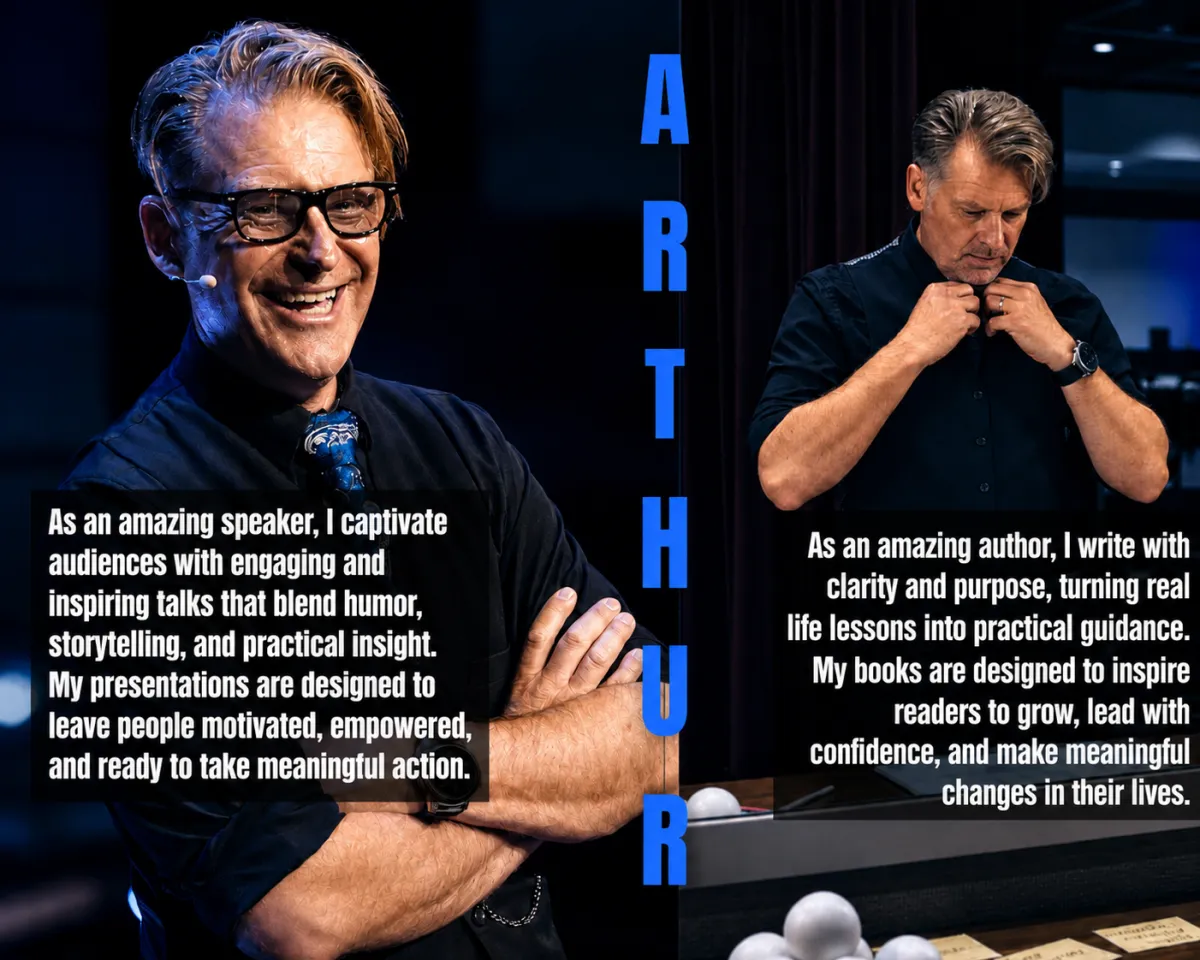
Not Just a Corporate Speaker, But an Author Inspiring Meaningful Change
The Amazing Arthur joined us for our annual office holiday party and we couldn't be more impressed and happier with the entertainment he provided. From the initial booking to communication leading up to the event through to the very end of the evening, Arthur was professional, kind, organized and most importantly, entertaining. He had the entire crowd laughing for an hour straight! Thanks for sharing your talents with our group, we thoroughly enjoyed the show and appreciate you!

Hired for an event and what a professional and amazing performer. He was on time for our event, gave an "amazing" performance, and we couldn't believe how reasonable his rate was for such a great show. Hands down the best entertainer in Omaha and would not hesitate to hire him again. Easy 5 Stars!

We booked Arthur for our Corporate Christmas party. He kept a room of 450 thoroughly entertained for the complete show. To make every demographic watch, laugh, pay attention and entertain is truly Amazing! If you are looking for entertainment for your next corporate event. Yeah, get this guy. Worry about other party details, and definitely not the entertainment, when you have Arthur booked.

Laugh, Learn, and Be Inspired with me.
Need your audience awake without making the coffee stronger?
Whether you’re booking a comedy show, a motivational talk, or a special event, Arthur delivers unforgettable moments filled with laughter and insight.