What the Magician Knows: Why Attention Controls What We See
Are You Watching Closely? What Magicians Know About Attention
After enough years of doing magic on stage, you start to notice something.
It is not really about deception.
Deception, subterfuge, misdirection. Those are the words people use when they want to make magic sound sinister or mysterious in a cheap way.
The word I prefer is attention.
As a magician, you become aware of what the mind notices, what it ignores, what it rushes past, and what the brain quietly invents to fill in the gaps.
That is one of the strangest things about performing for real audiences. People do not simply see what happened.
They see what the moment allowed them to see.
And later, they remember what their mind found useful, dramatic, or plausible.
I cannot tell you how many times someone has come up to me years after a show and described an effect I did and gotten it almost right.
Close, but not quite.
Memory is fallible. Imagination is helpful. And together they are more than willing to rewrite reality.
That is true in magic.
It is also true almost everywhere else.
People Do Not See Everything
Stand in front of enough audiences and you learn very quickly that people do not see everything.
They see what is lit.
What is framed.
What is pointed to.
What arrives with confidence.
And what their brain reconstructs after the fact.
Once you begin noticing that onstage, you start seeing it everywhere else too.
Marketing.
Politics.
Career.
Status.
Leadership.
Storytelling.
Human beings like to imagine they are objective observers moving calmly through reality, gathering facts like little truth librarians.
They are not.
Most of us are moving through the day with selective attention, incomplete information, emotional assumptions, and a very flattering opinion of our own accuracy.
That is not an insult.
It is just how perception works.
Magic, Perception, and Misdirection
People often ask how magicians create impossible experiences.
The answer is not just sleight of hand.
It is structure.
It is timing.
It is framing.
It is misdirection.
It is attention control.
A good magician does not merely hide the method.
A good magician shapes the conditions under which the audience will misunderstand what they are seeing.
That is a very different thing.
Magic is not just about fooling the eye.
It is about understanding how the mind builds reality from fragments.
That is why magic has always interested me as more than entertainment.
It is a working model of human perception.
It reveals how easily attention can be guided, how strongly confidence affects belief, and how much of our experience is assembled after the fact.
What the Magician Knows
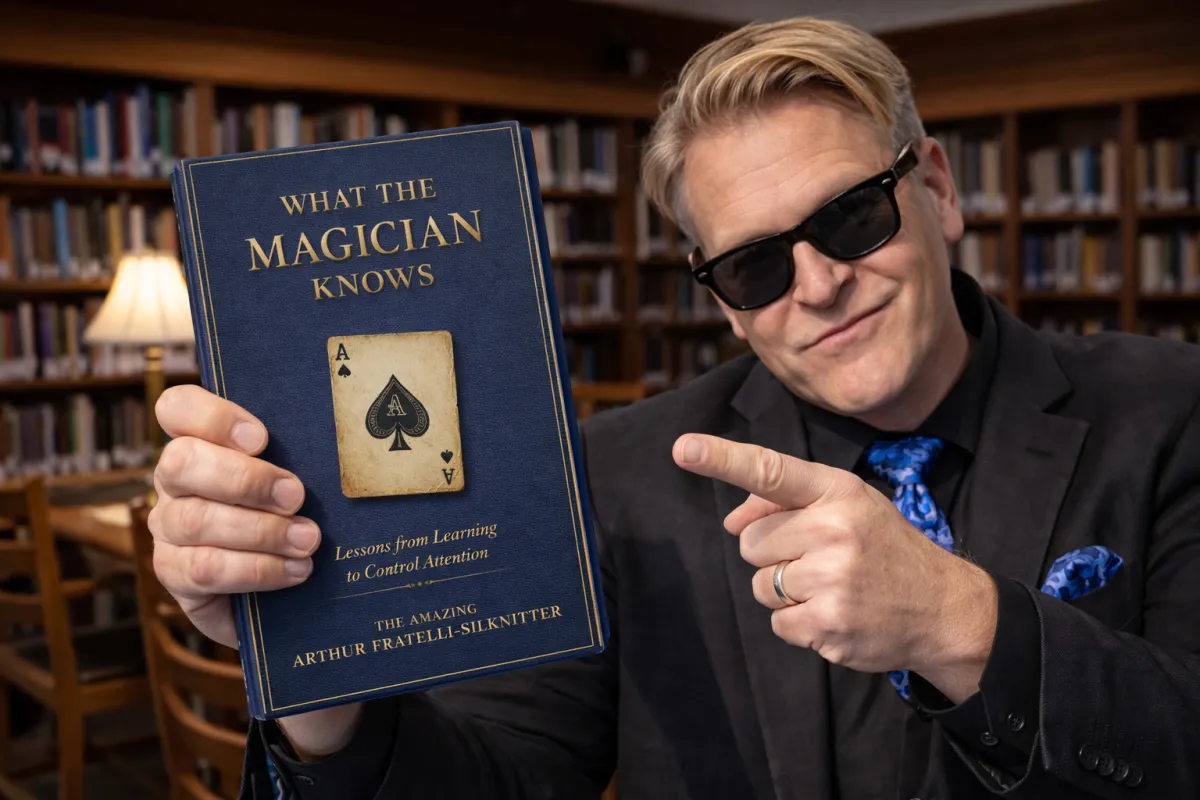
That is the idea behind my new book, What the Magician Knows: Lessons from Learning to Control Attention.
It begins in the world of magic, but it does not stay there for long.
The book moves into:
attention
perception
belief
framing
misdirection
memory
performance
hidden psychology
human behavior
It asks simple questions with surprisingly strange answers:
Why do people believe what they do?
Why do they miss what is right in front of them?
How much of everyday life is assembled out of someone else’s confidence, framing, and selective attention?
And once you start asking those questions, ordinary life begins to look a little less ordinary.
Why This Matters Beyond Magic
What magicians know turns out to matter far beyond the stage.
If you understand attention, you begin to understand persuasion.
If you understand framing, you begin to understand influence.
If you understand misdirection, you begin to see how often people are led toward one interpretation while the real mechanism sits elsewhere.
That is true in advertising.
It is true in leadership.
It is true in media.
It is true in relationships.
It is true in culture.
The interesting part is almost never where people think it is.
First in a New Series
What the Magician Knows is the first book in my What the _____ Knows series, followed by What the Hypnotist Knows, with more to come.
This first book is about attention.
About perception.
About how people see, miss, assume, and remember.
And about what years of standing in front of audiences can teach you about the hidden architecture of human experience.
Are you watching closely?
Because I am just getting started.

Where Leaders, Dreamers, and Decision Makers Stay Ahead.
Exclusive insights, show updates, and powerful ideas delivered straight to you.
Laugh, Learn, and Be Inspired with me.
READY TO be amazed?
Whether you’re booking a conference, a motivational talk, or some uniquely strange special event, Arthur delivers unforgettable moments filled with laughter and insight.