

Ideas That Challenge.
Stories That Inspire.
Explore insights on focus, leadership, communication, psychology, and personal growth—drawn from years on stage, behind the scenes, and in everyday life.
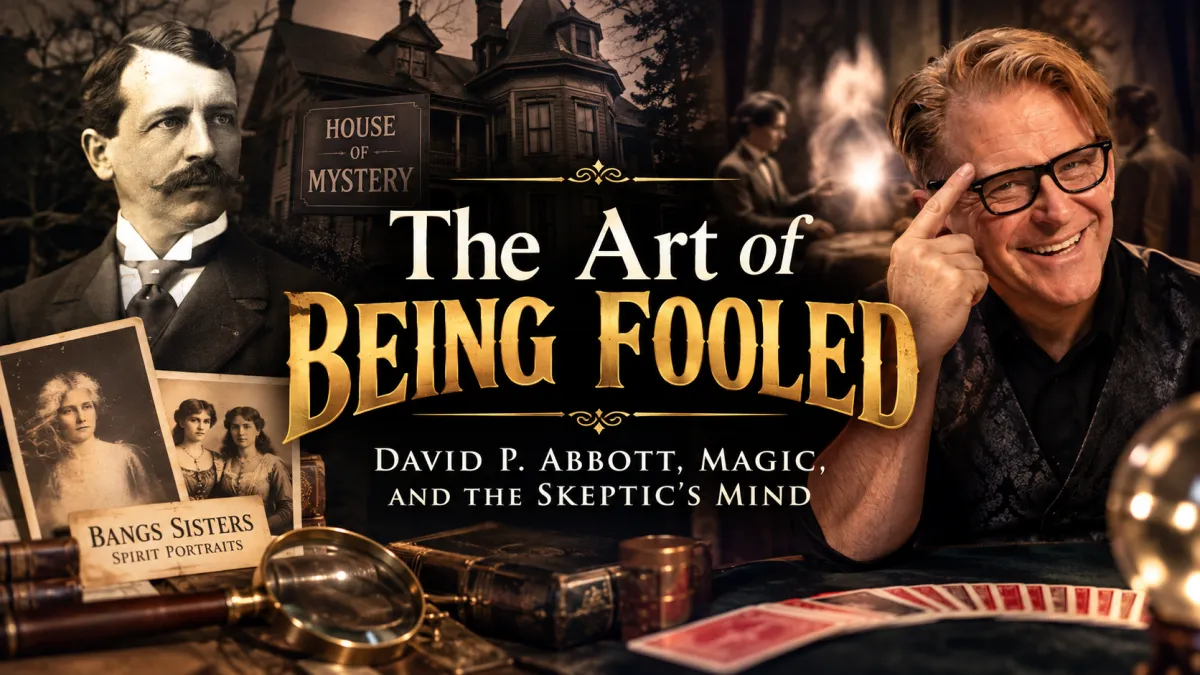
The Art of Being Fooled: David P. Abbott, Magic, and the Skeptic’s Mind
Part of being a magician is learning to be a skeptic.
Once you've spent enough time behind the curtain, you realize just how easily people can be fooled.
And maybe more importantly, you realize you can be fooled just as easily.
I was thinking about that recently while giving a presentation to my Toastmasters Reveliers group at Early Bird in Omaha.
The presentation was about one of the most fascinating characters in Omaha history: magician, inventor, and skeptic David P. Abbott and his legendary House of Mystery.
At the end of the presentation, I performed a mentalism routine that would have fit perfectly into the strange world Abbott inhabited more than a century ago.
The video below captures some of that presentation and the ideas behind it, including the final moments of the mentalism routine as the prediction is revealed and the audience reacts.
For me, though, the trick was only part of the point.
The bigger idea was skepticism.
Who Was David P. Abbott?
David P. Abbott was an Omaha businessman, magician, inventor, and investigator of supposed psychic phenomena.
He became known among magicians for the unusual demonstrations he performed inside his home, which eventually became known as the House of Mystery.
Abbott lived during a period when spiritualism, mediums, séances, and supposed communications with the dead were enormously popular.
People were willing to pay for messages from beyond the grave.
Objects moved.
Writing appeared.
Images materialized.
Mediums seemed to know things they couldn't possibly know.
Sound familiar?
Abbott was fascinated by these demonstrations, but he approached them with the eyes of a magician.
Instead of immediately asking, "Could this be supernatural?"
He also asked:
"How could someone create the appearance of this?"
That is a very different question.
The Bangs Sisters and "Spirit Portraits"
One of the most fascinating examples involved the Bangs Sisters of Chicago.
The sisters became famous for producing what were called "spirit portraits"—images that supposedly appeared through supernatural or psychic means.
To the people watching, the effect could seem impossible.
To Abbott, it was something worth investigating.
He studied these kinds of demonstrations and explored ways they could be duplicated through trickery rather than supernatural power.
That distinction matters.
There is a big difference between a magician saying:
"I'm going to fool you."
And someone saying:
"I possess supernatural abilities, and you should give me money because I can communicate with someone you lost."
One is entertainment.
The other can become exploitation.
"A Fraudulent Psychic?"
During my Toastmasters presentation, I talked about the people who claimed to possess these extraordinary abilities.
And yes, I know what some people are thinking.
"A fraudulent psychic?"
IMO, that's the definition of an oxymoron.
But there's a serious idea underneath the joke.
More than 100 years ago, people paid mediums to communicate with the dead, receive mysterious messages, and uncover supposedly impossible information.
Today?
A lot of it has simply moved online.
The séance table became the smartphone.
The newspaper advertisement became the social media ad.
The storefront psychic became the livestream, the DM, the subscription service, or the online reading.
The technology changed.
Human psychology didn't.
Everyone Needs a Skeptic's Toolkit
One of my favorite ideas comes from the book The Fifth Agreement:
"Be skeptical, but learn to listen."
I love that idea because real skepticism isn't the same thing as automatically saying no.
It isn't cynicism.
It isn't assuming everyone is lying.
It isn't refusing to consider a new idea.
Good skepticism means asking better questions.
What is the evidence?
What am I assuming?
Could there be another explanation?
Who benefits if I believe this?
Am I believing something because it is true, or because I want it to be true?
That last question can be uncomfortable.
It's also incredibly useful.
Magicians Are Professional Students of Being Fooled
One of the reasons I love magic and mentalism is that the field forces you to think about these questions constantly.
My job is to create a shared experience where people willingly allow themselves to be fooled.
That's the bargain.
The audience knows I'm creating an illusion.
I know they know.
They know I know they know.
And then we have fun anyway.
But the interesting part is that the principles involved in magic aren't confined to the stage.
Attention.
Assumption.
Expectation.
Perception.
Misdirection.
Memory.
Pattern recognition.
Suggestion.
Those same ingredients show up everywhere.
Advertising.
Sales.
Social media.
Politics.
Relationships.
Scams.
Online misinformation.
And yes, supposed psychics and mediums.
Once you learn how these things work, you don't become impossible to fool.
That might actually be one of the most important lessons.
You just become more aware of how easily it can happen.
Knowing the Secret Doesn't Make You Invincible
There's a strange trap that comes with learning magic.
You start seeing how an effect works and thinking:
"I would never fall for that."
Then another magician fools you completely.
And it's glorious.
Because it reminds you that knowledge doesn't make you immune.
Experience doesn't make you immune.
Intelligence doesn't make you immune.
Confidence definitely doesn't make you immune.
In fact, sometimes confidence becomes part of the trap.
If you ever find yourself thinking:
"I'm too smart to be fooled."
That is probably a good time to check your pockets.
Why the David P. Abbott Story Matters in Omaha
One of the things I love most about this story is that it happened right here in Omaha.
David P. Abbott's House of Mystery wasn't in New York.
It wasn't in London.
It wasn't hidden somewhere in Hollywood.
It was here.
Omaha has this incredible piece of magical history sitting right in its backyard.
Abbott entertained magicians and visitors inside his home with inventions, illusions, and mysteries that became legendary within the magic community.
At the same time, he was examining the claims of people who presented trickery as genuine supernatural power.
That combination fascinates me.
He loved mystery.
He loved magic.
But he also wanted to know what was really happening.
That feels like the perfect combination:
Wonder without gullibility.
Curiosity without surrendering critical thinking.
Bringing the Abbott House Story to the Stage
This Toastmasters presentation was my first talk specifically about David P. Abbott and the House of Mystery.
It was also only my second time performing the mentalism routine you see in the video.
That's one of my favorite parts of developing material.
You try something.
You listen to the audience.
You figure out where the laughs are.
You figure out where the story needs more room.
You discover where the mystery can become stronger.
Then you go back and build it again.
The presentation was a LOT of fun, and I'm looking forward to evolving it to the next level of AMAZING!
There's so much more I want to explore with Abbott, Omaha history, the age of spiritualism, skeptical thinking, and the strange overlap between magic and belief.
Because ultimately, magic isn't just about fooling people.
It's about attention.
Curiosity.
Wonder.
And sometimes learning to ask:
"What else could be going on here?"
Learn More About Omaha's David P. Abbott House of Mystery
If you live in Omaha and have never heard about David P. Abbott and his House of Mystery, it's absolutely worth exploring.
The Omaha Magical Society continues to preserve and share Abbott's legacy.
You can learn more about David P. Abbott and the House of Mystery through the Omaha Magical Society:
https://theomahamagicalsociety.org/mystery-house
And remember:
If you ever think you're too smart to be fooled...
Trust me.
That's usually when you're easiest to fool.
Laugh, Learn, and Be Inspired with me.
Need your audience awake without making the coffee stronger?
Whether you’re booking a comedy show, a motivational talk, or a special event, Arthur delivers unforgettable moments filled with laughter and insight.